Hello everyone!
Would you like to see some samples of our Basic 2, Intermediate 2 and Advanced 2 Level tests? Here you've got several links of different EOIs where you can find exam samples to get extra practice.
1. Ejemplo de Exámenes de Certificación EOI Región de Murcia
2. Ejemplo de Exámenes de Certificación EOI de Euskadi
3. Ejemplo de Exámenes de Certificación EOI de Zaragoza
Sunday, 20 May 2012

Tuesday, 24 May 2011
food, food, food!

- Questionnaire - Healthy food Vs Junk food

- Questionnaire - Key
- Food Vocabulary

- Food Recipes

- Speaking Activities
- Listening Activities
- GRAMMAR - Files 8A/8B
Monday, 23 May 2011
Reported Speech
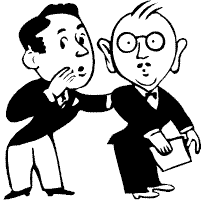
Grammatical Explanations:
Practice:
- Reported Speech (1)
- Reported Speech (2)
Thursday, 19 May 2011
The Passive Voice & Environment


Here you go some extra activities about the Passive Voice.
- The Passive Voice (1)
- The Passive Voice (2)
- Present Passive
- Past Passive
- Past Passive by + Noun
- Handout about Environment and Global Warming. Click HERE if you want to download it onto your personal computer or laptop.
Wednesday, 18 May 2011
Back to school...
View more documents from Rafaarabit33.
Click HERE to download that document.
Would you like to know more vocabulary about this topic? If so, click on this LINK.
And what about an interesting video about Education in the USA? (American English accent)
Click HERE to download that document.
Would you like to know more vocabulary about this topic? If so, click on this LINK.
And what about an interesting video about Education in the USA? (American English accent)
GRAMMAR PRACTICE:
- Used to + Infinitive (1)
- Used to + Infinitive (2)
I hope you like it!
Saturday, 14 May 2011
Present Perfect Vs Past Simple
On Thursday we were revising Present Perfect with "for" and "since" and when to use Present Perfect or Past Simple. Now I can provide you with some links for you to practise these two verb tenses.
Note: Provide someone with something - proporcionar algo a alguien.
- Present Perfect + for/since (1)
- Present Perfect + for/since (2)
- Present Perfect + for/since (1)
- Present Perfect + for/since (2)
- Present Perfect or Past Simple? (1)
- Present Perfect or Past Simple? (2)
- Present Perfect or Past Simple? (3)
- Present Perfect or Past Simple? (4)
- Present Perfect or Past Simple? (5)
- Present Perfect or Past Simple? (6)
Wednesday, 11 May 2011
At the pharmacy / chemist's
View more documents from Rafaarabit33.
- Asking for medicine
- Vocabulary & Listening
Tuesday, 10 May 2011
Friday, 6 May 2011
Giving advice
SEE THE LATEST UPDATE! Would you like to practise the verb "GET"? If so, try this Crossword.Theory and practice: - Should / Shouldn't (1)- Should / Shouldn't (2) - Should / Shouldn't (3) - Should / Shouldn't (4) - Should / Shouldn't (5) Now try this writing exercise: Agony AuntOnce you have finished, click HERE to get the key and check your answers.Finally, have a look at this powerpoint presentation. What advice would you give these people? Feel free to leave a reply.Giving advice
Thursday, 5 May 2011
Have you ever been jealous?
Listen while you read these "Express English" interviews about jealousy
Blog entry by courtesy of my colleague Teresa Bastida.
Blog entry by courtesy of my colleague Teresa Bastida.
Tuesday, 3 May 2011
I might go shopping tomorrow...
THEORY - may / might (possibility, formal request):

Revision:
- be going to / might / would like to + Infinitive
Activities to practise:
Revision:
- be going to / might / would like to + Infinitive
Thursday, 14 April 2011
Second Conditional

VIDEO 1 - SECOND CONDITIONAL
- GRAMMAR EXPLANATION
- ACTIVITIES TO PRACTISE
- CONDITIONAL TESTS
- Second Conditional Test (2)
* What would you do if you won 10,000 dollars, pounds, euros, yens...?
Watch these interviews and get some inspiration in case it happens to you in the future.
VIDEO 2 - WHAT WOULD YOU DO IF...?* What would you do if you won 10,000 dollars, pounds, euros, yens...?
Watch these interviews and get some inspiration in case it happens to you in the future.
* If you had three wishes, what would they be?
What did people in London answer when the BBC asked them this question? Listen and read this round of interviews.
VIDEO 3 - IF I HAD THREE WISHES...
VIDEO 4 - SONG
Monday, 11 April 2011
Zero and First Conditionals

Well, even if you think it’s all mumbo jumbo, superstitions come in very handy for the grammar point of this post, first conditional sentences. Here is a video on the topic by Jennifer, an American teacher you already know from earlier posts on this blog.
If you are not subscribed to English with Jennifer, do it now.
VIDEO 1 - FIRST CONDITIONAL
VIDEO 2 - ZERO CONDITIONAL
- GRAMMAR EXPLANATIONS
- ACTIVITIES TO PRACTISE
- CONDITIONAL TESTS
First Conditional Test
I'll stay as long as you need me - Me quedaré siempre que me necesites.
"provided (that)" - (siempre que)
The company will pay the bonus provided (that) the job is completed on time - La empresa dará un plus siempre que el trabajo se complete a tiempo.
"unless" - (a menos que)
You won't succeed unless you work harder - No tendrás éxito a menos que trabajes más.
- OTHER CONJUNCTIONS USED WITH FIRST CONDITIONALS
I'll stay as long as you need me - Me quedaré siempre que me necesites.
"provided (that)" - (siempre que)
The company will pay the bonus provided (that) the job is completed on time - La empresa dará un plus siempre que el trabajo se complete a tiempo.
"unless" - (a menos que)
You won't succeed unless you work harder - No tendrás éxito a menos que trabajes más.
Friday, 8 April 2011
Wednesday, 6 April 2011
Prepositions of movement and direction
Hi guys! here you go a list of links to practise and improve your use of these prepositions. I hope you find it useful.
VIDEO - Prepositions of Direction
- INFORMATION ON PREPOSITIONS Excellent grammar explanation
VIDEO - Prepositions of Direction
NOTE: There is a mistake: Fish are not ON the water. They are IN the water.
Sunday, 3 April 2011
Practice makes perfect: the more, the better.

Here you go a useful link with lots of short videos to practise listening at home. The good thing is that you can listen to these people while watching them on the video.
Click HERE to start working on it. Important: There is a CC button (Closed Captions=subtitles), so as you watch the video, you can also read the text by turning on that button.
Thursday, 31 March 2011
I love sports... what about you?
Watch the following video and try to answer the questions below.
- What's the sport you can see on the video? Yeah! you are right.. it's American football!
Think about that sporting event and answer these questions:
- What's the sport you can see on the video? Yeah! you are right.. it's American football!
- What do you think about this NFL (National Football League) advertisement /əd'vɜ:tɪsmənt/ (anuncio)?
- Do you think the video is real or a fake?
- Do you think the video is real or a fake?
- Would you like to play this sport? Why (not)?
Here you go another video. It's the most exciting sporting event I've ever watched on TV.
- Did you watch it?
- When and where did it take place?
- What teams were taking part?
- What was the final result? Who scored the goal(s)?
- In your opinion, who was the best player?
- Where did you watch that match?
- What was your reaction when the match finished?
By courtesy of Sergio Viñals.
By courtesy of Sergio Viñals.
Wednesday, 30 March 2011
How to use NO and NOT

What's the difference between no and not?
La palabra not se utiliza para expresar negación en una gran variedad de situaciones. Por ejemplo, se utiliza con los adjetivos y adverbios:
- “Are you hungry?”"Not really.”
- Not many of my friends use Skype.
Y con los verbos:
- You’re not my mother!
- Don’t (do not) go there! It's a dangerous place.
Acuérdate de utilizar not con el infinitivo y el gerundio:
- Remember not to go to bed too late. (Remember to don’t go to bed too late. X)
- He’s worried about not being able to find a job. (He’s worried about don’t find a job.X)
La palabra no se utiliza en dos situaciones:
1. Para respuestas negativas.
- Do you like this music?
- No, I don’t.
2. Antes de sustantivos, con el significado de not..any o ningún/ninguna.
- There’s no bread left.
- She had no reason to tell me.
- There are no oranges in the fridge.
Un error común es decir no cuando se debería decir not.
- “How are you?” “No bad.”X –> Not bad.
- I play football, but no basketball. X –> I play football, but not basketball.
Aunque not aparece antes de un sustantivo (basketball) en este último ejemplo, significa I don’t play y no ningún/ninguna; por eso no utilizamos no en este contexto.
- I play football, but I don’t play basketball. = I play football, but not basketball.
Exercises. Fill in the blanks with no or not:
1. “How often do you go out?” “____ often.”
2. A good movie should make you think, ____ just entertain you.
3. I have plans on Saturday, but ____ on Sunday.
4. “Do you like heavy metal?”"____, ____ really.”
5. “What’s new?” “____ much.”
6. One of the great things about living in the city is ____ having to drive.
7. I have ____ idea why he did that.
8. That’s ____ necessarily true.
9. There’s ____ way I’m eating that!
Answers:
1. “How often do you go out?”"Not often.”
2. A good movie should make you think, not just entertain you.
3. I have plans on Saturday, but not on Sunday.
4. “Do you like heavy metal?”"No, not really.”
5. “What’s new?” “Not much.”
6. One of the great things about living in the city is not having to drive.
7. I have no idea why he did that.
8. That’s not necessarily true.
9. There’s no way I’m eating that!
By courtesy of Zac Tobias.
Tuesday, 29 March 2011
Must / Mustn't / Have to / Don't have to
What's the difference? When do you need to use each of them? If you want to learn more about them, click HERE.
Are mustn't and don't have to different? What do you think? Of course they are different! Have a look at this LINK to learn more about it.
ONLINE EXERCISES
OPTIONAL EXERCISES (Expansion)
- Must Vs Have to
Are mustn't and don't have to different? What do you think? Of course they are different! Have a look at this LINK to learn more about it.
ONLINE EXERCISES
OPTIONAL EXERCISES (Expansion)
QUIZZES
- Must Vs Have to
Monday, 21 March 2011
Gerund or Infinitive?
1 - The Infinitive (with to)
Use the infinitive:
- Alice went to France to visit her old friends.
- I went to the party to meet new people.
- I came to this school to learn English.
- My phone number is easy to remember.
- Is there any part of your town where it's dangerous to go at night?
- He learned to cook at school.
- Have you ever forgotten to turn off your mobile phone in a cinema?
- Try not to be late tomorrow.
- She'd like to take part in the competition.
2 - The Gerund (with -ing)
Use the gerund:
- Flying makes me nervous.
- Singing is good for your health.
- He left without saying goodbye.
- Are you interested in visiting Egypt?
- I'm thinking of buying a new car.
- Thank you for being my best friend.
- He doesn't mind doing the washing-up.
- Sorry! I'm afraid I can't go to the cinema with you. I have to go on working until 9pm
- Please stop talking.
- She quit smoking two years ago.
- How long do you spend studying?
Gerund or Infinitive?
When two verbs go together, the second verb is often in the infinitive or in the gerund (the -ing form). There are no fixed rules regarding which form the second verb takes, so when you learn a new verb it’s a good idea to learn the verb pattern. Unfortunately, there are some verbs that can be followed either by the infinitive or the gerund with no real difference in meaning: For example:
The verb "start" can have both patterns with no difference in meaning:
- It started to rain = It started raining. (They have the same meaning).
Use the infinitive:
- To express a purpose:
- Alice went to France to visit her old friends.
- I went to the party to meet new people.
- I came to this school to learn English.
- After adjectives:
- My phone number is easy to remember.
- Is there any part of your town where it's dangerous to go at night?
- After some verbs (decide, try, forget, help, hope, learn, need, offer, want, plan, pretend, promise, would like):
- He learned to cook at school.
- Have you ever forgotten to turn off your mobile phone in a cinema?
- Try not to be late tomorrow.
- She'd like to take part in the competition.
2 - The Gerund (with -ing)
Use the gerund:
- As the subject of a sentence:
- Flying makes me nervous.
- Singing is good for your health.
- After prepositions:
- He left without saying goodbye.
- Are you interested in visiting Egypt?
- I'm thinking of buying a new car.
- Thank you for being my best friend.
- After some verbs (enjoy, like, dislike, love, hate, mind, spend, finish, start, stop, continue, quit, go on)
- He doesn't mind doing the washing-up.
- Sorry! I'm afraid I can't go to the cinema with you. I have to go on working until 9pm
- Please stop talking.
- She quit smoking two years ago.
- How long do you spend studying?
Gerund or Infinitive?
When two verbs go together, the second verb is often in the infinitive or in the gerund (the -ing form). There are no fixed rules regarding which form the second verb takes, so when you learn a new verb it’s a good idea to learn the verb pattern. Unfortunately, there are some verbs that can be followed either by the infinitive or the gerund with no real difference in meaning: For example:
The verb "start" can have both patterns with no difference in meaning:
- It started to rain = It started raining. (They have the same meaning).
But in the case of verbs, such as “stop”, "remember", "forget" and "try" the meaning changes:
- I stopped to smoke after working for two hours. (You had a break and smoked a cigarette.)
- I stopped smoking. (You abandoned the habit)
- I'm trying to find a new job, but it's very hard. (make an attempt)
- Why don't you try doing yoga? (experiment with something)
- Remember to bring your dictionary tomorrow. (keep something in mind)
- Do you remember meeting him last year? (remember something after it happened)
- I can't forget to post this letter. (omit something unintentionally)
- I will never forget meeting the King. (forget something after it happened)
After "make" and "let" we have to use the infinitive without "to".
- Singing makes me feel good.
- We like John very much because he makes us laugh a lot.
- I'm grounded! My parents don't let me go out today.
Have you had enough practice? If not, you can get more practice by clicking on the following links: (os recomiendo estos links y ese blog en general, es de los mejores que conozco para aprender inglés)
- Problemas con el Infinitivo en Inglés
- Problemas con el Gerundio en Inglés
ONLINE EXERCISES: The best way to learn verb patterns is through practice, practice, practice! Why don't you start, then, by doing these exercises?
- Infinitive with "to" (1)
- Infinitive with "to" (2)
- Gerund (1)
- Gerund (2)
- Gerund or Infinitive (1)
- Gerund or Infinitive (2)
- Gerund or Infinitive (3)
- I'm trying to find a new job, but it's very hard. (make an attempt)
- Why don't you try doing yoga? (experiment with something)
- Remember to bring your dictionary tomorrow. (keep something in mind)
- Do you remember meeting him last year? (remember something after it happened)
- I can't forget to post this letter. (omit something unintentionally)
- I will never forget meeting the King. (forget something after it happened)
After "make" and "let" we have to use the infinitive without "to".
- Singing makes me feel good.
- We like John very much because he makes us laugh a lot.
- I'm grounded! My parents don't let me go out today.
Have you had enough practice? If not, you can get more practice by clicking on the following links: (os recomiendo estos links y ese blog en general, es de los mejores que conozco para aprender inglés)
- Problemas con el Infinitivo en Inglés
- Problemas con el Gerundio en Inglés
ONLINE EXERCISES: The best way to learn verb patterns is through practice, practice, practice! Why don't you start, then, by doing these exercises?
- Infinitive with "to" (1)
- Infinitive with "to" (2)
- Gerund (1)
- Gerund (2)
- Gerund or Infinitive (1)
- Gerund or Infinitive (2)
- Gerund or Infinitive (3)
Subscribe to:
Posts (Atom)